

 A. J. Philip
.jpg)
On Bakrid this year, I wanted to wish my Facebook friends in a slightly different way. I asked ChatGPT to create a Bakrid greeting poster. Within a minute, it produced an elegant design. There was a mosque minaret, a crescent moon, worshippers offering prayers and, prominently, a goat. The composition was attractive, but the goat troubled me.
I could have deleted just the animal and retained the rest of the poster. Instead, I deleted the entire image and posted a simple text wishing my friends a happy Bakrid (Eid al-Adha).
A little later, my friend and Indian Express cartoonist EP Unny sent me a Bakrid greeting. It was beautiful, tasteful and calligraphic. I immediately shared it on Facebook, giving him full credit.
My hesitation about using the AI-generated poster was soon echoed elsewhere. A Catholic school in Srinagar uploaded an Artificial Intelligence-generated Bakrid greeting on its website. The poster reportedly offended some people. The management removed it and apologised.
The episode reminded me how sensitive symbols can be. The goat is inseparable from Bakrid because it represents Qurbani, or sacrifice. The festival commemorates Prophet Ibrahim's willingness to sacrifice his son in obedience to God's command. In Islamic tradition, God intervened and substituted an animal for the child.
The story is not exclusive to Islam. It is equally sacred to Christians and Jews. Abraham occupies a central place in all three Abrahamic faiths.
Sheep and goats are recurring motifs in both the Quran and the Bible. Bulls, too, are frequently mentioned as sacrificial animals. What is striking, however, is that references to the consumption of cow meat are rare or absent in the religious narratives that shape these traditions. Yet modern political battles over cattle often have little to do with theology and much to do with economics.
This brings me to an extraordinary development in West Bengal.
Every year, around two weeks before Bakrid, livestock markets in Muslim-majority areas become active. Goats are brought in large numbers. The buying reaches its peak a day or two before the festival.
Islamic teaching prescribes that the meat from a sacrificed animal should be divided into three parts: one for the family, one for relatives and friends, and one for the poor. Whether this ideal is fully observed is another matter, but the principle reflects the festival's emphasis on sharing.
Because mutton has become prohibitively expensive, many poorer families depend on beef as a cheaper source of protein. Consequently, cattle owners often bring old cows and bullocks to markets where Muslim buyers purchase them.
West Bengal has had restrictions on cow slaughter since 1950. However, successive governments interpreted and enforced the law with considerable flexibility. As a result, cattle could be legally slaughtered under specified conditions, much as they are in Kerala and several Northeastern states.
That situation has now changed dramatically.
The new government issued strict instructions requiring two certificates before any animal can be slaughtered. One must come from the municipality chairperson or the panchayat head. The second must be issued by a government veterinary doctor.
Such certification is allowed only if the animal is over 14 years old, permanently incapacitated, incurably diseased, or no longer useful for breeding or work.
In practical terms, obtaining these documents is difficult enough to amount to a near-ban.
The consequences became visible almost immediately.
Thousands of cattle were brought to markets in anticipation of Bakrid sales. Yet Muslim buyers and traders refused to purchase them. Why would anyone buy an animal that could not legally be slaughtered without risking prosecution?
The result was economic devastation.
Owners who expected to earn between ?5,000 and ?20,000 per animal found themselves returning home empty-handed. Some abandoned the cattle on roadsides. Others vented their anger on the police, who were merely enforcing government orders.
For many urban residents, this may appear to be a minor issue. It is not.
A farmer who loses ?20,000 on a single animal would need to sell enormous quantities of potatoes, tomatoes or beans to recover the same amount. When you buy a kilogram of potatoes for ?30, the farmer often receives less than ?10. Livestock serves as a form of rural savings, insurance and investment.
When governments suddenly remove the market value of cattle, they effectively demonetise an important rural asset.
That is precisely what appears to be happening.
The implications become clearer when one examines livestock statistics.
India has conducted a livestock census every five years since 1919. It is the largest exercise of its kind in the world. The 21st census has been completed, but the data have not yet been released.
We must therefore rely on the 20th Livestock Census conducted in 2019. The figures are revealing.
West Bengal had approximately 3.74 crore cattle and goats combined. Of these, 1.9 crore were cattle and 1.62 crore were goats. The state's cattle population had increased by around 15 per cent compared with the previous census.
This fact alone challenges a widely held assumption.
Many people believe that permitting slaughter automatically reduces cattle numbers. The West Bengal experience suggests the opposite. Farmers continued rearing cattle because they knew unproductive animals retained some market value.
Once an animal stopped producing milk or became unsuitable for agricultural work, it could still be sold. That income helped farmers purchase younger and more productive animals.
Remove that option and the economics collapses.
Maintaining an unproductive cow can cost between ?100 and ?300 a day. For small farmers, this is unsustainable. Consequently, many simply abandon their animals.
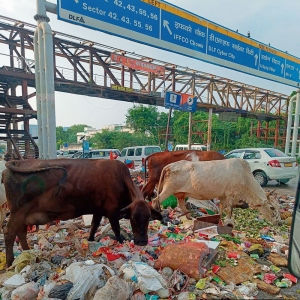
One does not have to travel far to witness the results. Delhi's roads are full of stray cattle. Their stomachs bulge not because they are healthy but because they consume plastic bags along with discarded vegetable waste.
These animals are often diseased, malnourished and neglected. Ironically, laws intended to protect cattle sometimes condemn them to prolonged suffering.
Consider Haryana, which has some of India's toughest anti-cow slaughter legislation.
The state was once renowned for its indigenous cattle breeds. During my years as a journalist, I travelled extensively through Haryana. Cattle were everywhere.
Yet the 2019 census recorded only 90.5 lakh bovines, of which 59.53 lakh were buffaloes. Many states, including Uttar Pradesh, Maharashtra, Karnataka, Odisha and Gujarat, reported negative cattle growth.
The decline is not difficult to explain.
Traditional bullocks once commanded high prices because they were indispensable for ploughing and transport. Mechanisation changed everything. Tractors replaced bullocks. Farmers no longer had economic reasons to maintain large numbers of male cattle.
Nationally, the indigenous cattle population declined from 151 million to 142 million.
The trend is likely to have accelerated since then.
The Rashtriya Gokul Mission seeks to preserve indigenous breeds. The objective is admirable. But conservation cannot succeed if farmers bear all the costs and receive none of the benefits.
An instructive example comes from Kerala.
The state is home to the famous Vechur cow, one of the smallest cattle breeds in the world. Much of the credit for saving it from extinction goes to Dr Sosamma Iype, a retired veterinary professor and conservationist from Pathanamthitta.
Years ago, while staying at a YMCA guest house in Aluva, I visited a nearby home that kept Vechur cows. It was my first encounter with the breed.
The animals were astonishingly small, rarely exceeding 87 centimetres in height. They produced only 1.5 to 2 litres of milk daily, but that milk commanded premium prices because of its perceived medicinal value.
Vechur ghee fetched even higher prices.
Today, certified Vechur cows can sell for around ?1 lakh. Dr Iype's efforts earned her a Padma award and ensured the survival of a unique genetic resource.
Interestingly, Kerala has never banned cow slaughter. Yet it remains one of India's dairy success stories.
According to the livestock census, Kerala had only about 13.5 lakh cattle. However, around 94 per cent were crossbreeds. Milk productivity per animal was the highest in the country.
The transformation did not happen accidentally.
One of the architects of Kerala's dairy revolution was Philipose Thomas, former Director of Dairy Development. I recently learnt more about his contribution through "The Kerala Club: Keepers of the Flame," edited by KM Chandrasekhar and TP Sreenivasan.
In the volume, former IAS officer R Narayanan describes the mass crossbreeding programme launched during the tenure of Chief Minister C Achutha Menon.
Before the programme, the Thiruvananthapuram dairy handled only 2,000 to 3,000 litres of milk daily. Today, it handles several lakh litres.
A local cow that once yielded a litre of milk per day was transformed into an animal producing 15 to 20 litres.
Such progress depends on rational economics. Farmers invest in cattle because productive animals generate returns and unproductive animals can be disposed of without ruining the household economy.
If that balance is disturbed, dairy production itself becomes vulnerable.
The release of the 21st Livestock Census data will therefore be eagerly awaited. It may reveal whether stringent anti-slaughter laws have actually helped or harmed cattle populations.
The issue extends beyond cows. Some states have imposed restrictions even on buffalo slaughter. Farmers who shifted from cattle to buffaloes may soon face similar economic difficulties.
Ironically, India continues to rank among the world's major beef exporters despite increasingly restrictive laws.
The contradiction is striking.
Public policy often appears designed to satisfy symbolism while ignoring economics.
Five years from now, West Bengal may no longer hold its position as India's leading cattle-rearing state. If that happens, the reasons will not be biological. They will be political.
Let me clarify one thing. I am not writing this because I have any desire to eat beef. I do not consume it, whether in Delhi, Kerala or abroad.
Nor is it my business to question the faith of those who regard the cow as sacred.
What I do find intriguing is the selective application of religious logic.
Many defenders of cow protection emphasise the spiritual superiority of indigenous breeds. They point to distinctive features such as the hump and dewlap, and invoke concepts like the Suryaketu Nadi, supposedly enabling these animals to absorb cosmic energy and confer unique properties on their milk, urine, and dung.
If that belief is sincerely held, one can understand why indigenous cows are treated differently.
But why should the same reverence automatically extend to European and Scandinavian crossbreeds? Why should poor farmers be prevented from selling them once they become economically useless?
The question deserves an answer.
Perhaps the most candid response came from West Bengal minister Agnimitra Paul. She reportedly said that the cow was her mother, but that killing it after the age of 14 was acceptable.
That statement unintentionally captures the contradictions surrounding the entire debate.
For years, India has approached cattle policy through the lens of emotion. Emotion has its place, but agriculture runs on economics. When sentiment overrides livelihood, farmers pay the price. The challenge is to protect faith without destroying incentives. Otherwise, the animal we claim to revere may ultimately become the greatest victim of our reverence.
India needs a cattle policy guided by compassion, science and economics rather than slogans. Farmers must not be forced to choose between faith and survival. A productive animal economy requires incentives, not prohibitions. If cattle lose their economic value, both farmers and the animals themselves will inevitably suffer.
.jpg)
.jpg)
.png) Jacob Peenikaparambil
Jacob Peenikaparambil

.png) John Dayal
John Dayal
.jpeg)
.png) Joseph Maliakan
Joseph Maliakan

.png) Dr Arnald Mahesh SDB
Dr Arnald Mahesh SDB

.jpg) Jose Vattakuzhy
Jose Vattakuzhy
.png)

.jpg) Isaac Gomes
Isaac Gomes
.png)
.png) Robert Clements
Robert Clements