

Priya (name changed) has been coming to our seminary campus every Christmas for over twenty-four years. She is a practising Hindu—open, thoughtful, unafraid to ask sharp questions about what Christians believe and how we celebrate. About the priesthood, about the meaning of celibacy.
This last point has always fascinated her. "It is not usual in our tradition that someone at a young age like you sacrifice their entire lives for God," she told me once. Her wonder was genuine. She understood sannyasa—renunciation—but to see young men embrace it so completely, to devote themselves wholly to prayer and service, struck her as both strange and compelling.
This curiosity is unremarkable here at Seminary Hills. Our Christmas celebrations have always drawn not only Catholics and Christians, but families from the Sikh, Muslim and Hindu communities of Nagpur—people of different faiths, seekers, and the simply curious. The seminary has never been a closed space. Christmas is for everyone.
This past December, as we walked together through the crowds moving between the elaborate nativity displays, she paused and said something that caught me off guard.
"Father, the celebrations have become so much more glamorous. But something is missing."
The campus had indeed been alive with a constant tide of visitors that day—families, children, young couples navigating the paths between the various cribs set up by the seminary and the religious houses surrounding it: the Pallottines, the Poor Servants of Divine Providence, the Norbertines, and the Dominicans. Many came to pray. Many came to celebrate.
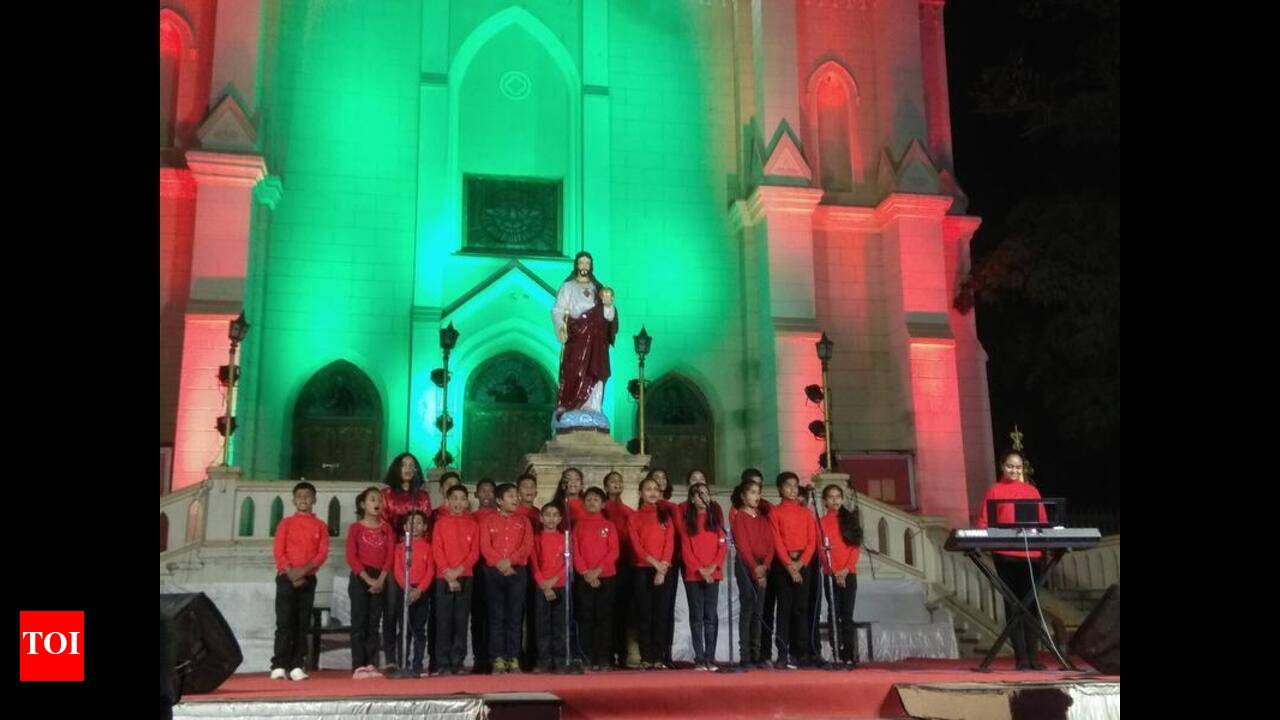
Our campus in the heart of Nagpur, with its generous greenery, quiet beauty, and open spaces where usually only the sound of birds can be heard—a sanctuary amid the city's noise—had taken on an entirely new look. The lights strung across every path and building cast the campus in colour. The DJ system muffled what had always been audible: the sound of birds, wind, prayer at a distance. There was even a selfie point for people to immortalise their visit. People danced in the open areas. Children ran laughing between the displays. The nativity scenes were sophisticated, carefully staged. Each told the Christmas story with artistic precision.
It looked, by every visible measure, like a successful celebration. By modern event management standards, it was a triumph. But Priya, who had brought her husband, her two boys—one in eighth standard, one in fifth—and her nephew, saw something different. We had walked together through the crowds, moving from the church where they had prayed to the various cribs scattered across the campus, pausing at the seminary's main display where the lights were brightest and the music loudest.
Between the waves of visitors, we found small pockets of quiet, moments where we could actually talk. And in one of those moments, she spoke.
"Everything's changed so much," she said. "It's all so glamorous now. The lights, the music—bigger, brighter. Everything." She looked back toward the main crib, where people were taking pictures. "But it doesn't feel the same. There was something else here twenty years ago."
I knew exactly what she meant. But I asked her to articulate it anyway. "The brothers," she said, turning to look at me directly. "Where are the brothers who used to stand at the crib? Who used to greet people when they arrived? Who used to explain what the crib meant, what the story was trying to tell us? I remember, every year there would be a different theme, and the brothers would help us understand it. They would ask if we had questions. They would pray with us if we wanted. Now we just see the lights and hear the recordings. There is so much noise. But there is no one there to help us understand. No one to speak with us. No one who is just ... present. It feels like we are watching a show. A beautiful show, yes. But just a show."
She gestured toward the nearest display, where a recorded voice was playing on a loop, explaining the nativity. We stood there in silence for a moment, the music pounding around us, the lights flashing in rhythm. Priya's two sons had run ahead to another display, and her nephew was taking a selfie in front of the manger. The crowd surged and shifted. We were standing still.
And I realised: she was right. She had seen what I had stopped seeing. Priya, who had returned faithfully for over twenty-four years, had kept watching. I had turned away.
The reason I had stopped seeing it was my inability to address the malaise. It is easier to avert one's eyes from a wound one cannot heal. For several years, I had watched the brothers disappear from the cribs year after year. I had seen the DJ system grow louder, the lights grow brighter, the spectacle deepen, while the presence diminished. And I had felt helpless to reverse it. So I stopped looking. And then I joined in. But now she had spoken. And I could no longer look away.
Here is a woman who has been coming to us for Christmas for reasons truly admirable—and, I believe, these are precisely the kinds of people we should have kept in mind when we prepared our Christmas celebrations. We pour resources into these celebrations—months of preparation beginning in November, budgets, and the labour of brothers. And wouldn't one expect all of this to serve a single purpose: to welcome and encounter the seekers who come? We owe it to her.
Twenty years ago, a visitor approaching the main crib at our seminary would encounter something unremarkable and yet essential: a brother standing nearby. Not performing. Not guarding the display from a distance. Simply there—available, present, ready.
The brother would greet them upon their arrival. "Welcome. Have you seen our crib this year?" And if they paused, if they showed interest, he would explain the theme. Each year, the crib told the Christmas story from a different angle: Christ born in poverty, the Incarnation as God's entry into our suffering, the Holy Family's flight into Egypt. The brother didn't lecture. He translated. He helped visitors see what they were looking at—not just a beautiful arrangement of figures and animals, but the story—the theology, the proclamation—as an invitation to pray.
If someone had a question, the brother answered. If someone wanted to pray, the brother prayed with them. If someone simply wanted to stand in silence before the mystery, the brother respected that silence and stood with them. The encounter was unpredictable, unscripted, and vulnerable. The brother couldn't control how people responded. He could only offer himself—his presence, his time, his willingness to meet whoever came, whatever they might say. This was not extraordinary. This was simply how it was done.
But gradually, without any single decision or official announcement, the brothers disappeared from the cribs. Not all at once, but in a slow drift—what looked like growth but was actually a displacement. And in their place came other things: more lights, more music, recorded messages looping, elaborate staging, professional sound systems. The production values improved. The displays became more sophisticated. But the presence—the person standing there, ready to encounter whoever approached—vanished. The loss, I have come to realise, is pastoral and theological at once. We have replaced Incarnation with production.
The absence of the brothers troubled me deeply. In Christmas 2023, aware of this growing absence, I decided to do something—anything. I went to the photocopy room and printed Scripture verses on small slips of paper—the Word of God in a form suitable for distribution. I asked the seminarians to stand at the main entrance gates and offer these slips to visitors as they arrived, using the occasion to welcome them and, if possible, to strike up a conversation.
It was modest, but I hoped it would accomplish two things: give those arriving something more than spectacle—an actual encounter with the living Word—and train the brothers themselves not to be afraid to go out and meet people, to risk rejection, to stand vulnerable before a stranger. The experiment revealed how deep the problem runs.
Brother Benedict (name changed) came to me at the gate an hour later, discouraged. "Father," he said, "most of the people are giving us back the Word of God. They do not seem to be interested. Wouldn't it be a better idea to hand out sweets along with the Word of God? That way they might be more inclined to receive it?" Some gave it back politely. Others simply discarded it.
I looked at him. "What do you think is sweeter, dear brother? You are training yourself to be a dispenser of God's eternal Word, and you should never grow weary or discouraged, no matter how people respond." I have not invented this exchange. I recall his words and my response almost verbatim. The moment was too vivid to forget.
Surely it would be much less difficult to run a candy dispenser. Hand out sweets, guarantee a smile, avoid rejection, and manage the outcome. The seminarian wanted to soften the starkness of the encounter—to cushion the vulnerability of standing there with nothing but the Word. He wanted, in other words, what the DJ system and the elaborate lights already do: make the message more comfortable by wrapping it in something easier to consume.
But the Word of God is not a product to be packaged and made attractive. It is a person to be proclaimed. And proclamation requires presence—vulnerable, unmediated, willing to be rejected. I told Brother Benedict what every preacher must learn: some will reject the Word. It is to be expected. Your task is not to candy-coat the Gospel but to keep offering it. As a priest, you will devote your life to proclaiming this Word. Never be ashamed of it. Wear it like a diadem on your forehead. Carry it in your hands like a flaming sword. Shake the dust from your feet and go to the next village if you are rejected. But never stop proclaiming.
The brothers' absence from the crib, then, is not merely a practical failure or a shortage of hands. It is a formative crisis. We have not trained ourselves—nor them—to stand present, unarmed, before those who come seeking. We have trained ourselves for production, not for witness. We have taught ourselves to manage, to mediate, to make things more palatable.
And this is the deeper sickness that Priya put her finger on without naming it. When she said, "the celebrations have become more glamorous, but something is missing," she was pointing to the wound: we have replaced the Incarnation with a show. What was missing was the energy of witness—martyria, the living testimony of a life poured out in service to God.
The Incarnation is not a display. It is the eternal Word becoming flesh—God making himself present through the particularity of a human nature, a place, a moment in time. Christmas celebrates this scandal: that the infinite God is encountered not in spectacle, but in the vulnerability of a child, the poverty of a stable, the quiet witness of Mary and Joseph.
The brother standing at the crib once lived this out. His presence was the proclamation. God does not announce himself through equipment. God shows himself through a face.
What we have now is the opposite. We have DJ systems that blast noise to fill the silence left by the absence of a human voice. We have recorded messages that explain the crib—perfectly, efficiently, in multiple languages—but cannot respond to a question, meet someone's eyes, pray with a grieving mother, or welcome a curious child. We have lights that dazzle, music that overwhelms, and staging that impresses. But we do not have presence. And without presence, the crib becomes what Priya said it has become: a beautiful show. Just a show.
You cannot automate the Incarnation. Priya understood this without naming it. She had come back, year after year, hoping to meet someone standing at the crib. And year after year, she had. Let's stop standing in her way.
.jpg)
.png) Jacob Peenikaparambil
Jacob Peenikaparambil
 A. J. Philip
.jpg)
.png) Cedric Prakash
Cedric Prakash
.jpg)
 P. A. Chacko

.jpg) Thomas Menamparampil
Thomas Menamparampil
.png)
.png) Robert Clements
Robert Clements
.jpg) A. J. Philip
A. J. Philip
 Jacob Peenikaparambil