


The instruction came the moment I climbed into the van.
"Father, go back and change," my brother said, hands on the steering wheel. "Jeans and a T-shirt. Casuals."
It wasn't a suggestion. It was a security measure.
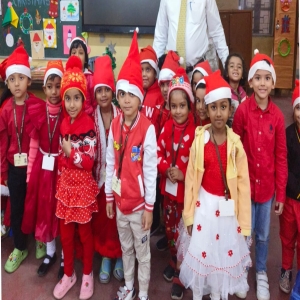
We were heading to the nursery school that our priory runs. There would be a quick Christmas program: gift distribution, a dance, a few carols, and a blessing. Nothing complicated.
But the ambience in the van had shifted. Joy gave way to cold calculation. My white Dominican habit—the thing that usually opens doors, that says I'm here to help—suddenly it had become something else. Something risky. Something that could draw the ire of a hostile crowd.
In a country where extremist groups use religion as a pretext to hurt people, this visible sign of faith was a liability. To me. To them. To the kindergarten staff and children.
I could see genuine worry in my brother's eyes. Not ashamed about his faith, but concerned for the safety of everybody. And yet: "I'd rather not go at all," I said, "than go in disguise."
It was a tense moment.
The instinct to hide wears the mask of prudence. After some hesitation, I gathered some courage and sat in the van. I kept the habit on. We drove.
Throughout the short trip to the venue, I prayed to the Lord and the Archangel Michael not to let anything happen that would vindicate those who had warned me.
We approached the school. My joy in the small victory of keeping my habit would not last long. My companion, dressed in sensible civilian clothes, positioned himself at the entrance of the kindergarten—baalwadi in the local dialect. He stood there like a guard, looking up and down the street, muscles tensed. He was making sure no neighbours saw us—especially, that no one saw me.
I walked past him, head down, feeling less like a shepherd entering his flock and more like a criminal being smuggled across a border. I had won the battle of the habit, but inside I was anxious. I walked into that room praying the words of the Psalmist: "In you, Lord, I have taken refuge; let me never be put to shame." (Psalm 31:1)
The shame would come anyway. But not from the "radicals" outside.
I understood my brother's anxiety. We all live with it now. It was the same apprehension I had seen in the eyes of another brother at an orphanage recently. There, I was teaching the children a bhajan—a devotional hymn. It was a simple moment: singing about God, about love. But as I sang, a Name rose naturally to my lips, as it must in any Christian hymn. Jesus. Christ. The Lord. It was written into the bhajan we were singing.
The priest came running. Not in anger: in panic. His face was strained, his gestures urgent. He pulled me aside and, in a low voice, gave me systematic instructions. Wherever the hymn mentioned Jesus, I was to replace His Name with generic titles of divinity: Eeshwar. Prabhu. Bhagwan. God. Lord. Master.
"Father," I said, "it is a Christian hymn. And this is our house."
He looked at me with a mixture of exasperation and pity, as if I had missed something fundamental about how to survive in a country that is hostile to Christian witness. "We cannot afford to be specific," he said. "We would be accused of proselytising. The NGO will lose its funding. The orphanage will close. And who knows what more? No more food, no more shelter for these children..."
His logic was sound. His fear was not irrational. The anti-conversion laws are real. The vigilance committees are real. The threats are real. A priest witnessing to his faith in an institution that serves poor children from all backgrounds—in his mind, that was a recipe for disaster.
I got it. So I obeyed. I taught them to sing 'Eeshwar' instead of 'Jesus,' 'Prabhu' instead of 'Christ.' I replaced the Name with the title—the Person with the abstraction.
As I did so, a question haunted me: if we give our children food but cannot name the One who is Bread, have we fed them? This is not an accusation. It is a lament. Because we have all learned to make this compromise. Our foremost concern is safety and the survival of our institutions.
The bargain with the forces of destruction, I later realised, has shaped me more than I know. It had become a default posture of my priesthood: keep the faith, but keep it quiet. Serve the poor, but give them a deracinated God. Be a priest, but be a prudent priest.
When I walked into that nursery school classroom that day, this instinct was inside me. It did not need to be said aloud; it had already been absorbed.
The kindergarten children and their teachers received us warmly, without any hint of suspicion. There was no sign of the "trouble" we had been warned about. The two caretakers greeted us with genuine warmth. They seemed pleased to see us and the priest in his white robes. There was no antipathy in their eyes; no sense that we were unwelcome intruders in their space.
And yet, I was afraid.
Not of the children. Not of the teachers. The fear I carried had been planted in me while I was leading songs in that orphanage. I had nurtured it every day since. I supposed that if I spoke the Name clearly, I would call down catastrophe. This fear has become so common that we no longer even recognise it as fear. We call it wisdom. We call it pastoral sensitivity.
When the time came for me to say a few words to the children about Christmas, my mind was not on the Gospel. I was absorbed in prudent calculation. I was caught between my need to witness and my responsibility to protect the institution. What could I say that is true, but not specific? How could I witness to Christmas without witnessing to Christ? How could I speak without saying anything? It startled me to discover that I had plenty of clever ideas.
I stood before those tiny faces, open and receptive, waiting to hear something sacred. I began to speak. The words that came out were hollow. They were certainly not the words of a shepherd to his flock. I spoke about "values"—kindness, love, sharing. I spoke about "the season"—joy, light, togetherness. I spoke about "God"—abstract and inoffensive.
I did not speak about the Incarnation. I did not speak about the Son of God who became Man. I did not speak about Jesus.
My training had worked. Without being told or pressured, I followed the rule: Keep it safe. Protect the institution.
I had come as a witness, but what I witnessed to was fear.
Even as I was speaking, I knew something was profoundly wrong. These children deserved better. The two women who had welcomed us deserved better. Christ Himself deserved better than a priest so afraid of losing security that he could not speak of the Incarnation even on Christmas.
I finished. The children clapped. The teachers smiled. By every external measure, it was fine. Safe.
It was also a kind of death.
And then…
One of the teachers gently cut in. Perhaps she sensed that we were holding back. She did not wait for permission: she simply joined in naturally, as if she had been part of the plan all along.
"Children," she said, her voice soft but clear, "do you know what is special about the 25th of December?"
The room fell silent. The small faces looked up at her, waiting.
Their teacher smiled. And then, in a voice that held no apology, no hesitation, she gave them the answer: "It is the birthday of Bhagwan Yesu Krist." "Yesu Krist"—the Name I had not dared to pronounce.
Bhagwan. The Sanskrit word for the Divine. But she attached it to the Name. She did not dilute the specificity. She just stated it. Clearly. Respectfully. In front of these children.
The children listened. They did not riot or report us. Their parents did not come crashing through the doors to withdraw them from school.
No disaster. Thank God!
But what followed was something devastating to me: the realisation that the fear I carried within was not as rational as I had assumed.
I had allowed that fear to justify a surrender that went far beyond prudence into something closer to cowardice—to apostasy.
This teacher—unburdened by our institutional anxieties—had no such contradiction. She was freer than I was. Freer than all of us who have learned to calculate the cost of speaking the Name. And in her freedom, she became the voice I should have been. It was she, without my faith tradition, who proclaimed the Name of Jesus.
I stood there in my habit—the habit I had refused to remove—and realised that wearing it meant nothing if I would not speak the truth. The external sign of my identity had become a lie, concealing an internal cravenness.
The children went home. The kindergarten remained open. No one was harmed.
But something in me had died through my silence. It came to life through her speech. In that moment, I understood the words of our Lord to his disciples: "If these remain silent, the stones will cry out." (Luke 19:40)
The stones had cried out when the disciple did not.
But here is the question that haunts me now. The threats are real. The anti-conversion laws are real. The vigilance committees are real. Priests and nuns have been imprisoned and beaten. Churches attacked. Institutions shut down. My brother was not being paranoid. Neither was the priest at the orphanage.
My question is different. And far more troubling: at what point does prudence become a form of unfaithfulness?
We tell ourselves that we are protecting our institutions so we can continue to serve. The orphanage must stay open to feed the children. The kindergarten must remain safe for the poor. The school must survive to educate the next generation. All of this matters.
But what if, in the process of protecting an institution, we have compromised its mission? What if we have become so skilled at survival that we have forgotten its purpose?
I think about the priest at the orphanage again—not in a spirit of judgment, but with a kind of grief. He was trying to save his institution. But in saving it, he taught the children to sing about a God without a face, a Master without a name and a Saviour who will remain forever unnamed in their presence.
I think of myself, standing in that nursery school in my robes, preaching a generic Gospel to children who deserved the specific, earth-shattering truth of the Incarnation. I was wearing the uniform of a witness while acting like a defector. I was a living contradiction.
This teacher had no such contradiction. She had no funding to preserve, no anti-conversion laws to fear. She had something we seem to have lost: the freedom to speak the truth without hesitation, without calculation.
She could say the Name because she was not trapped in the machinery of survival.
But here is what troubles me most: we are trapped in this machinery by choice.
No one forced the orphanage priest to strip the Name of Jesus from the hymn. No one forced me to speak in abstractions. No law explicitly mandated that. We did it because we had absorbed a logic that says: the institution must survive. The truth must be managed. The Name must be hidden or whispered, if it is mentioned at all.
This logic has become so normal in our communities that we no longer see it as a choice. We see it as maturity. We tell ourselves we are recognising the realities of ministry in a challenging environment.
But what if, in trying to preserve our structures, we have lost our souls?
I do not know how to be both prudent and faithful, both realistic and prophetic. This is the dilemma we are in—all of us who work in the Church in India today. I don't know how to get out of it.
But I know this: A kindergarten teacher should not have to teach a Catholic priest how to speak the Name of Christ on Christmas. When she does, she shows us that we have a problem far deeper than the threat of Nationalist radicals. We have a problem with ourselves. Yet she did. And in doing so, she became my teacher in faith.
I am writing this not as an accusation against my brothers, but as a confession of my own complicity. I sleep in a bed provided through the very prudence I now question. I wear the habit that my brothers try to protect. I, too, have learned to lower my voice, as I did that day in kindergarten.
But on that day, I perceived something beautiful: the Gospel does not need our protection. It asks only for our witness. The Greek word for witness is μαρτυρ?α (martyria).
We have spent decades building schools, colleges, hospitals and orphanages to serve the people of this country. This is Christ's work. But if, in our anxiety to protect these structures, we silence the Name that gives them life, we are creating a Church that is present in brick and mortar but absent in spirit and truth.
I am uncertain how we can safeguard our institutions without diminishing the boldness of our proclamation. I do not know how we can survive in a political landscape that wants to erase us without erasing ourselves first. But I know this: I never again want to stand in a room full of children entrusted with the treasure of the priesthood but offering them a stone instead of bread.
The Lord Jesus has promised that the stones will cry out. What remains to be decided—by me, by my Order, by the Church in India—is whether we will raise our voices with them, or whether our silence will force stones to speak in our place.
.jpg)
.png) Jacob Peenikaparambil
Jacob Peenikaparambil
 A. J. Philip
.jpg)
.png) Cedric Prakash
Cedric Prakash
.jpg)
 P. A. Chacko
.jpg) Thomas Menamparampil
Thomas Menamparampil
.png)
.png) Robert Clements
Robert Clements
.jpg) A. J. Philip
A. J. Philip
 Jacob Peenikaparambil