

.png) Dr. Pauly Mathew Muricken
Dr. Pauly Mathew Muricken
We celebrate the 76th Republic Day to commemorate the 'greatness of the occasion' registered in the minds of our people 75 years ago. It is a thrilling moment of emotion when every citizen remembers they are Indians. Amid the spectacular military and cultural pageantry and 21 gun salutes, and with the tricolour waving above us, we celebrate the strength of our Constitution, a beacon of hope, a symbol of our commitment to justice, liberty, equality and fraternity. As we pay tribute to our fallen heroes, it is also an occasion to make a promise that we will not let the hard sacrifices of our brave freedom fighters go in vain.
A Republic is a State in which the supreme power rests in the body of citizens entitled to vote and is exercised by representatives chosen directly or indirectly by them. Today's democracies are also republics and are even referred to as democratic republics. The US, France, and India are considered democracies and republics, both terms meaning that the power of governance rests in the people. In these countries, the head of the State is not a hereditary monarch but is elected and installed.
The word 'Republic' originated from the Latin word' res publica,' meaning 'public thing', thereby characterising that a State is ultimately run by its people, as opposed to a monarchy. For about 500 years, ancient Rome was a republic before emperors ruled it. The city-state of Rome was a republican government from 509 BC, one of the earliest examples of representative democracies worldwide. Roman Forum was a place where meetings were held in public, and social and legal issues were debated. The Republic of Venice, a mercantile city-state of the Middle Ages, was led by a Doge (Duke) elected by wealthy merchants and served until his death.
Anatomy of the Indian Republic
India, also known as Bharat, is a Union of States. It is a sovereign, socialist, secular, democratic republic with a parliamentary system of government. The Indian Republic is governed by the Constitution of India, which provides for a parliamentary form of government that is federal in structure with certain peculiar unitary features.
The constitutional head of the executive branch of the Union is the President. Article 79 states that Parliament consists of the President and the two Houses of Parliament. Article 74(1) prescribes that there shall be a Council of Ministers with the Prime Minister as the head to aid and advise the President, who shall exercise the functions in accordance with the advice. This clarifies that the real executive power is vested in the Council of Ministers, with the Prime Minister as its head.
An Engaged Electorate
In a Republic, people hold power but elect representatives to exercise that power. They exercise political power. The Constitution not only provides the framework for how the Union and State Governments are structured but also places significant limits on their powers. It is true that "democracy" and "republic" have been historically pitted against one another. But like the Granny Smith apple, which is a form of apple, the republic is a form of democracy.
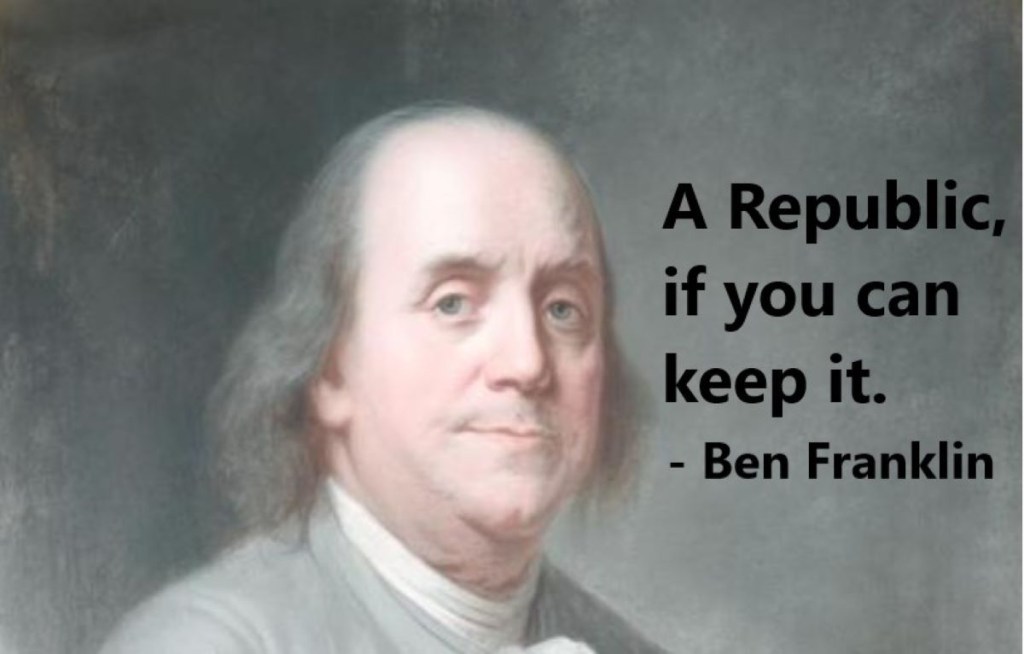
The Indian Republic is based on laws and not on majority rule. Majority rule often leads to tyranny because issues are mostly decided without considering the rights of the minority but by an overbearing majority. History tells us that when Benjamin Franklin, the founding father and chief architect of the US Constitution, exited Independence Hall in 1787, he was approached by a group of citizens asking what kind of government you gave us. He answered, "A republic, if you can keep it."
Our Founding Fathers crafted and gave us a Republic while retaining a democratic pattern of government to ensure that the minority and their rights would not be stripped away by the majority and to avoid a mob rule where 51 per cent of the people could take away the rights of the other 49. They definitely wanted to avoid situations like two wolves and a lamb voting on what to have for lunch.
People as the Masters
A republic derives its power and strength from the people. People are the real masters of a republic. Potential excesses of democratic majorities could weaken our customs and ethos. Indian republicanism and the ordered liberty it makes possible are grounded in the constitutional federal principle that non-majoritarian communities equally make legitimate contributions to the country's welfare. Preserving minority contributions is the hallmark of constitutional and political justice.
Indian republicanism possesses a noble inheritance, bought by the toils, sufferings and blood of our ancestors. It is reared for immortality. No other form of government has better stood the test of time. The republic of yesterday, today and tomorrow, if wisely improved and faithfully guarded, is capable of transmitting to our posterity and us all the substantial blessings of life, liberty, the pursuit of happiness, property, religion and independence. It is a constitutional panacea with adamantine strength and capable of withstanding the stream of time and curing the infected cells affected by societal evils in the form of corruption, inequality, crime, exclusion, and isolation.
An Epitome of Virtues
Republic is not an empire or dominion for political domination or to embark on conquest, but an epitome of virtues, employing only that extent of minimum restrictions on people's rights and freedoms which are reasonable, necessary, justifiable and proportionate, and have a legitimate purpose of satisfying in democracy.
Even otherwise, as ponderously stated by Lord Diplock in R v. Goldsmith (1983), "you must not use a steam hammer to crack a nut if a nut cracker would do." A republic always looks for balance, as it is built on the supreme will of the people. Indian republicanism is founded on the pillars of constitutional governance, limited government, rule of law and guided exercise of power.
Apathy among citizens in a republic is dangerous to republicanism. The spirit of inequality and extreme equality are excesses to be avoided. Egalitarianism must guide our republic with the deep presence of the core values of tolerance, broadmindedness, pluralism, compassion, and respect for human rights.
Refine Republican Institutions
Republican institutions must refine views, apply the brake to impetuous decisions, inject reason into impassioned debates, help make far-sighted decisions, and focus eyes on what could be seen and even unseen for a sustainable future. The inspiring words of wisdom shared by Joseph Story, the greatest American Jurist, are worthy of mention in this cherished moment. "Republics are created by the virtue, public spirit, and intelligence of the citizens. They fall, when the wise are banished from the public councils, because they dare to be honest, and the profligate are rewarded, because they flatter the people in order to betray them."
A long period of seventy-six years has passed by since the fledgeling republic was born. But the upcoming question is this: Is it deviating in any way from a full and deep republic? The vision, farsightedness, and wisdom of our founding fathers in constituting India as a workable republic may not be easily forgotten. The structured republic cannot be allowed to be shaken in any manner.
Walk with the People
The love of the republic is the love of democracy itself. The republic calls us to be with the people, to walk and work for the people. Preserving the freedoms we cherish and follow sometimes requires balancing exercises to achieve egalitarianism and a just society. We must, therefore, bolster the dimensions of equality, rights and accountability.
Swami Vivekananda beautifully painted the future of our republic when he said, "Let New India arise - out of the peasant's cottage, grasping the plough; out of the huts of the fisherman, the cobbler, and the sweeper." It is the solemn duty of all of us to preserve and keep the values of our indestructible republic and be the change we wish to see in this world.

.jpg)
 A. J. Philip
.jpg)
.png) Jacob Peenikaparambil
Jacob Peenikaparambil
.png) Chhotebhai
Chhotebhai

.jpg) P. A. Joseph
P. A. Joseph
.png)
.png) Robert Clements
Robert Clements
.jpeg) A. J. Philip
A. J. Philip
.jpg) Jacob Peenikaparambil
Jacob Peenikaparambil