

.png) Jacob Peenikaparambil
Jacob Peenikaparambil
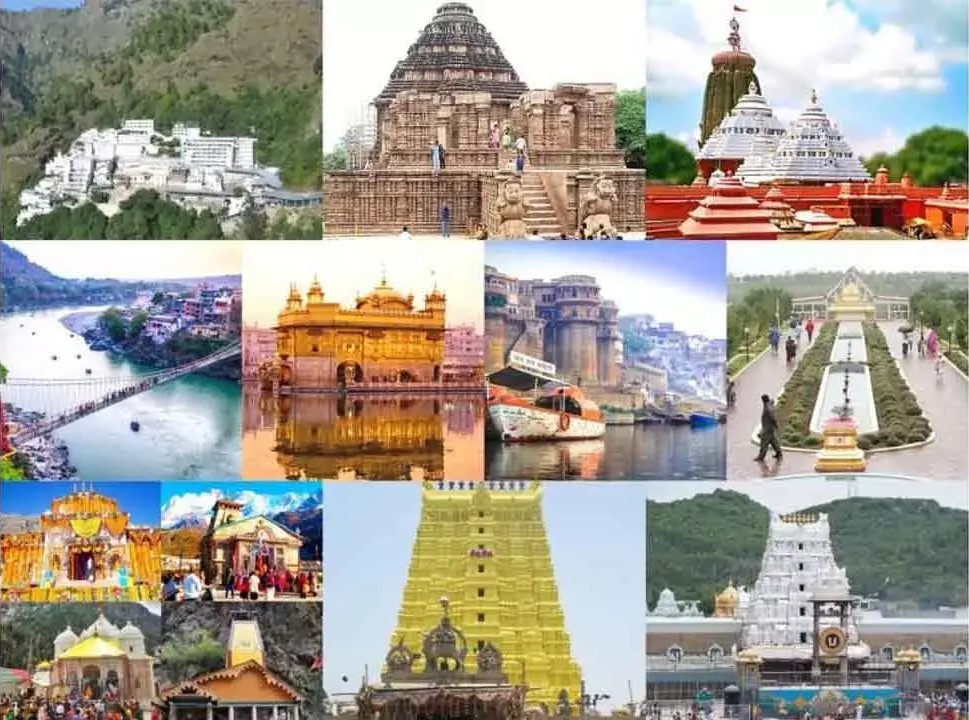
A new term gaining traction recently is "religious tourism." States ruled by the Bhartiya Janata Party (BJP) increasingly compete to develop religious sites to attract tourists. The Madhya Pradesh government, for instance, has decided to tender helicopter services to connect Indore with two major religious hubs: Ujjain and Omkareshwar. According to the Chief Minister of Madhya Pradesh, Mohan Yadav, the state government intends to identify places associated with Lord Ram and Lord Krishna and develop them as pilgrimage sites under the initiatives "Sri Ram Path Gaman" and "Shri Krishna Path Gaman." Additionally, the government has erected a statue of Adi Shankaracharya at Omkareshwar at the cost of Rs 2,200 crores.
In Uttar Pradesh, the Maha Kumbh Mela, with a projected budget of Rs 7,500 crores, was expected to generate a revenue of Rs 2 lakh crores. Media reports revealed that the rent for luxury cottages built in the Kumbh area for a single night ranged from Rs 18,000 to Rs 1,00,000.
The commercialisation of religion often goes hand-in-hand with the politicisation of faith. Alongside generating income, religious tourism hypes up devotion and fervour, which politicians exploit to garner votes.
Commercialisation occurs when religious practices, symbols, and institutions are exploited for financial gain, thereby diminishing their sacred essence. Pilgrimage centres, regardless of religious affiliation, have increasingly become centres of religious tourism, generating significant revenue through various means. Religious institutions often market items such as idols, sacred books, and relics, turning them into commodities. Many institutions also charge exorbitant fees for ceremonies and rituals. Additionally, religious leaders leverage television and social media to solicit donations under the pretext of divine blessings, targeting vulnerable followers. Large corporations sponsor religious festivals and events, branding them for profit rather than spiritual enrichment.
Several factors contribute to the commercialisation of religion. People in distress often turn to religious institutions for solace. They are often willing to follow any advice or prescription that these institutions offer, which may include costly rituals or donations. The marketplace also promotes festivals to boost product sales, turning even spiritual events into opportunities for commerce. In today's consumer-driven world, everything, including faith, is packaged and sold. Due to a desire for instant gratification or immediate results, people often fall prey to the tactics of self-proclaimed religious leaders. As long as religious rituals and tourism are promoted at the expense of the deeper spirituality and core values taught by religions, commercialisation will continue to thrive.
The commercialisation of religion is a distortion, leading to the exploitation of people. Jesus's cleansing of the temple, as depicted in Matthew 21:12-14, illustrates his strong condemnation of the exploitation of people in the name of God and religion. The Gospels portray Jesus as extraordinarily kind and compassionate, and only on rare occasions did he express anger. One such occasion was when he saw traders selling and buying animals and birds meant for sacrifice in the temple.
The renowned Biblical scholar William Barclay offers a compelling interpretation of why Jesus became angry. A Jew visiting the Jerusalem temple during the Passover was expected to offer one of three items: an ox, goat, or a pair of doves, in addition to paying the temple tax in shekels. Since Jews came from various countries with different types of currency, they had to exchange their money for shekels, with money changers charging exorbitant fees. Similarly, the cost of a pair of doves within the temple premises was far higher than outside the temple. Pilgrims were effectively forced to purchase their offerings from within the temple to avoid rejection by the priests, who might deem outside animals or doves defective.
According to Barclay, Jesus's anger was fuelled by the exploitation of pilgrims. The temple authorities treated them not as worshippers but as commodities to be exploited for personal gain. Exploitation of people always provokes the wrath of God, particularly when it is cloaked in the guise of religion. Jesus was also angered by the desecration of God's holy place. By commercialising the sacred, people were violating the sanctity of the temple.
Even after two thousand years of Jesus's condemnation of religious commercialisation, the phenomenon continues unabated in many religions. What, then, is the solution to this pervasive commercialisation?
One of the first steps in curbing the commercialisation of religion is educating people on the distinction between religiosity and spirituality. The essence of religion lies in practising the moral and ethical values that it teaches. For example, the core values taught by Jesus are summarised in the Sermon on the Mount (The Gospel according to Matthew, Chs. 5-7). Through parables such as the Good Samaritan, The Rich Man and Lazarus, and the Last Judgment, Jesus conveyed that genuine spirituality is rooted in selfless service to others in need. Rituals, structured prayers, and pilgrimages can be valuable as long as they inspire people to practice these core values.
Jesus, by his own example, taught his disciples that the best way to grow spiritually is through silent prayer, contemplation, or dialogue with God and oneself. According to the Gospels, Jesus frequently withdrew to mountains and solitary places to pray. He visited the temple primarily to teach the people, as they were readily available there.
Jesus taught his disciples only one prayer—the "Our Father"—even then, only when they asked him how to pray. Some Biblical scholars suggest that the "Our Father" prayer is not just a petition but a vision of the Kingdom of God and the ideal way of living in alignment with God's will. It represents a deep longing for the realisation of God's reign on earth.
Jesus emphasised that God's forgiveness is unconditional. What God expects from people is genuine repentance, a firm determination not to repeat sin, and a readiness to forgive others. In the parable of the Prodigal Son, Jesus illustrated that forgiveness does not require penitence like fasting or kneeling for hours. Instead, what is expected is an acknowledgement of mistakes and a commitment to avoid repeating them. Therefore, concepts like penance for the sins of one's ancestors, as advocated by some preachers, lack a biblical foundation.
If one's penance or sacrifice benefits another person, it becomes meaningful. For example, if a person sacrifices a meal and donates the savings to feed someone in need, such an act of penance makes sense. In Indian traditions, certain types of penance are said to enhance a person's willpower, but performing penance to appease or placate God seems futile.
People must also understand that God cannot be pacified or bribed through material offerings. Some godmen sell blessed water, stones, and other items, promising that purchasing them will fulfil one's wishes. These are deceptive tactics used by fraudulent spiritual leaders to exploit people. This does not mean that offering gifts to places of worship is inherently wrong. These offerings should be used to maintain worship centres and support charitable causes.
To prevent the commercialisation of religion, people must also be educated in critical thinking and scientific temper, as mandated by the Indian Constitution. Faith without scientific inquiry can quickly devolve into blind belief or superstition, which leaves people vulnerable to exploitation.
Charging money for spiritual services must be discontinued. Priests and spiritual leaders should be supported by the community, with each person or family contributing to their upkeep as decided by the community. The contributions by the faithful are to be used for an honorarium for the priests, the maintenance of worship centres, and charitable purposes.
Taking money from the faithful through coercion or deceit is immoral.
Building extravagant worship centres or erecting massive statues does not contribute to spiritual growth, and extracting money from people for such purposes cannot be justified. The faithful need simple, accessible spaces for prayer, spiritual discourses, and worship. These spaces should be constructed through communal contributions or, in the case of poor parishes and dioceses, assistance from donor agencies.
History shows that the commercialisation of religion is a harmful force that can destroy religion from within. Promoting true spirituality, grounded in selfless service and moral values, is the most effective way to liberate religion from commercialisation and politicisation. Only by focusing on the core teachings of faith can we ensure that religion remains a transformative and spiritual force in people's lives rather than a commodity for exploitation.
.jpg)
.jpg) Jacob Peenikaparambil
Jacob Peenikaparambil

.png) John Dayal
John Dayal
.jpeg)
.png) Joseph Maliakan
Joseph Maliakan

.png) Dr Arnald Mahesh SDB
Dr Arnald Mahesh SDB

.jpg) Jose Vattakuzhy
Jose Vattakuzhy
.png)

.jpg) Isaac Gomes
Isaac Gomes
.png)
.png) Robert Clements
Robert Clements