


.png) Dr Suresh Mathew
Dr Suresh Mathew

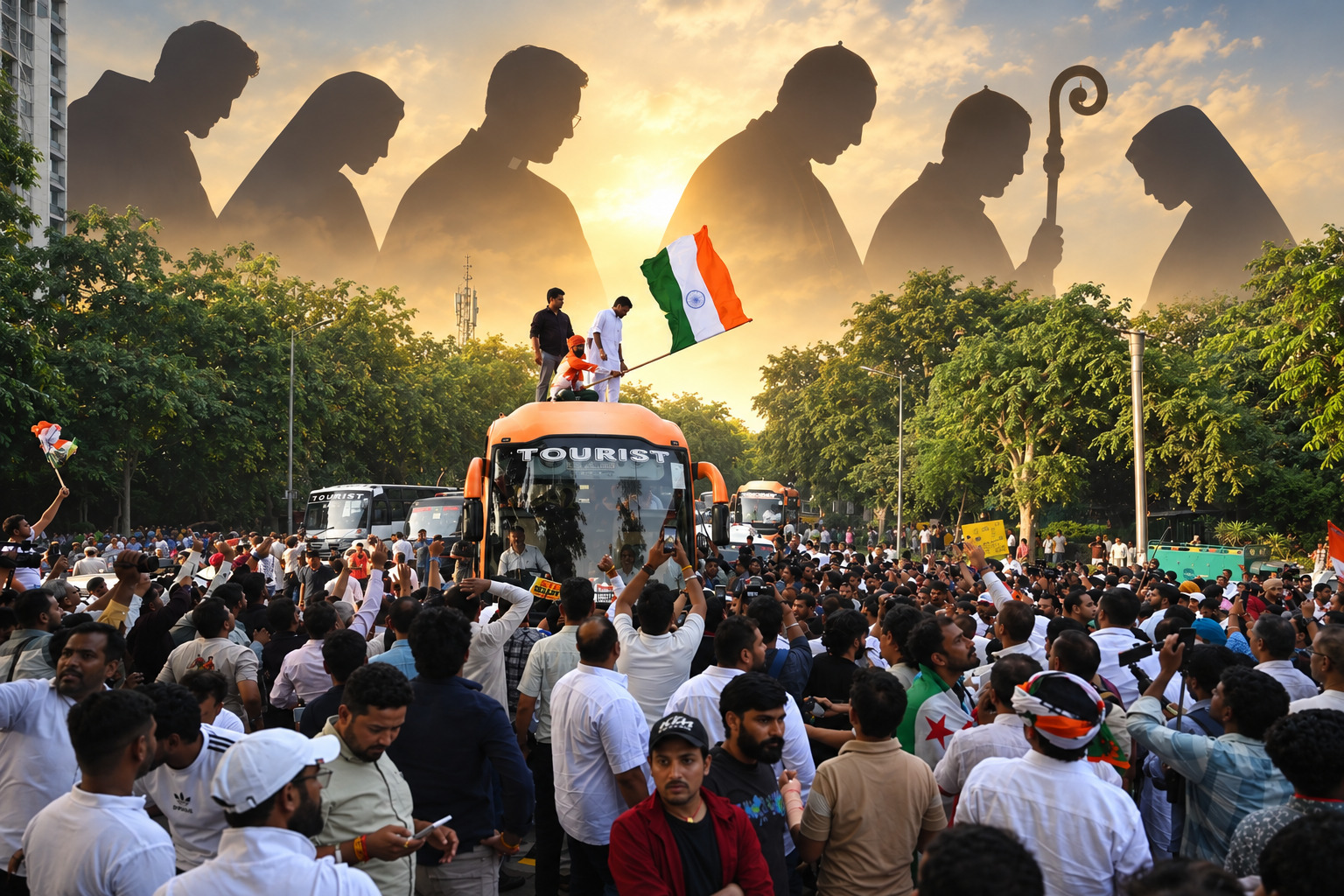
“The Christian educational institutions introduced a new spirit of understanding, a better appreciation of life in the community and gave an added impetus to a rethinking of values,” said none other than Sardar K. M. Panikkar, renowned historian. But the same Christian institutions, especially those run by the Catholic missionaries, are in distress and under duress.
Many of them, especially in North and Central India, are at the receiving end of Sangh Parivar outfits. The targets of attacks are mostly missionary schools, but, of late, the self-styled protectors of Hindutva have added institutions like hostels, orphanages and care homes for children to their hit-list.
The attacks by hooligans and ‘raids’ by government agencies in institutions take place as if on a scripted line. The last few years have seen an unprecedented rise in such uncivilized attacks. It will not be wrong to link the aggressiveness of the Hindutva forces with the coming to power of new regimes at the Centre and in some States.
The attacks take different forms: The members of the Sangh Parivar outfits barge into school compounds, inflict widespread damage to the buildings and scoot off with impunity; in some cases, they physically attack the management and the employees; in other cases, they ask the management to remove all symbols of Christianity from the premises; in some extreme cases, they inscribe symbols, slogans and salutation of Hinduism on the walls of the institutions.
Whatever be the method of aggression, the trespassers have the same ruse -- Christians are indulging in conversion. Whether it is the Hindutva forces who barge into the premises or the government agencies like the Child Welfare Committees which come in the ‘middle of night’ in the guise of ‘inspection’, all of them make the same fabricated allegation of ‘forcible conversion’.
There is no iota of truth in the charges made against the missionaries. The falsehood is exposed when every case falls flat in the courts and every person accused of forcible conversion gets acquitted. The conviction rate in cases against missionaries is as low as zero.
But it would be imprudent to not look at the other side of the story. There are cases in which the Catholic institutions are not prudent enough to follow the hair-splitting rules and norms relating to their area of work. Since several states have come out with stringent anti-conversion laws, those running the institutions should be thorough with the provisions of those laws, lest they should get trapped unwittingly for violation of those norms.
The institutional heads should not allow anything to happen that would ruffle the feathers of other communities. They should make sure that children of other faith are not asked to join Christian prayers or teachings. The institutions could inscribe teachings from all religions in common places.
The Christian institutions should be aware that the adversaries are looking for loopholes, howsoever minute they may be, regarding violation of laws on maintaining records, certificates, affidavits and a whole lot of such formalities. Hence, as described in one of the cover stories this week, Christian institutions have to diligently follow Jesus’s warning to his disciples, “Be shrewd as serpent, yet innocent as a dove”. Let them read the signs of the times and respond diligently to the challenges. Lack of preparedness could pose greater problems in these trying times.
.jpg) Stanislaus Alla
Stanislaus Alla
.jpg) Stanislaus Alla
Stanislaus Alla

 Adv. Rev. Dr George Thekkekara
.jpg)
 A. J. Philip

.jpg)
.png) John Dayal
John Dayal
.jpg)
.png) Jacob Peenikaparambil
Jacob Peenikaparambil
.jpg)
 P. A. Chacko
.png)
.png) Robert Clements
Robert Clements