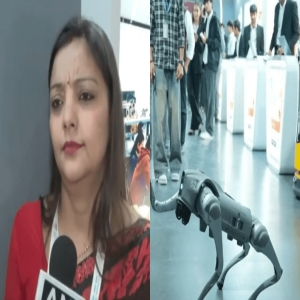



The controversy surrounding Galgotias University's attempt to fraudulently claim a robotic dog as its own creation was not merely an isolated act of misrepresentation. It was the moment when the underlying rot in Indian higher education—reshaped decisively since 2014—surfaced in plain view. What was exposed at the India AI Impact Summit 2026 at Bharat Mandapam is not merely one institution's shenanigans, but a larger system redesigned for optics over substance, expansion over excellence, and political signalling over academic credibility, which spells ill for India's future generations and the nation.
One cannot make sense of this proposition without first acknowledging how much the Indian higher education landscape has deteriorated since 2014. According to data from the Press Information Bureau (PIB) and the Ministry of Education's All India Survey on Higher Education (AISHE) reports, the number of universities in India rose from about 760 in 2014–15 to approximately 1,338 by mid-2025—an addition of around 578 new universities in just over ten years. Over the same period, the number of colleges increased from roughly 38,500 to over 52,000, adding 13,500. Taken together, universities, colleges, and standalone institutions (12,276) increased by nearly 18,500 entities.
This expansion, unprecedented in scale in the country's higher education landscape since independence, is presented as democratisation, progress, a knowledge powerhouse, and ambition made visible. Yet the numbers conceal a critical reality: the overwhelming majority of the new institutions are private and self-financed, many of them owned by politicians. That fact alone explains why extraordinary growth has coincided with mounting concern over quality, credibility, outcomes, and the job-hopping of ill-equipped graduates.
Importantly, the surge after 2014 was not driven by sustained state public investment or by a coherent, progressive academic vision. It was driven by policies that made private entry easy and public responsibility optional. Under Narendra Modi, governance has consistently emphasised what can be quickly inaugurated and showcased. In higher education, this meant approvals rather than endowments, announcements rather than functional institutions, and numbers rather than norms and quality.
Public institutions, on the other hand, are slow to build, expensive, and often intellectually autonomous, whereas private universities and colleges can be approved quickly, funded by exorbitant student fees, "dirty" money laundered, and showcased as achievements without long-term fiscal commitment. The creation of 578 new universities thus reflects not a growth in public scholarship, but a decisive shift toward market-led expansion, commerce and optics.
This obsession with optics also applies to the state's flagship promises. Since 2014, multiple new IITs and AIIMS have been announced with fanfare, and foundation stones laid and widely publicised. Yet several of these institutions remain partially functional or delayed far beyond original timelines. The announcement itself becomes the achievement, while completion and quality recede into the background. In education, as in infrastructure and economic activity, symbolism has substituted for substance in political messaging. A good parallel example is the contested claim that the country is the 5th-largest economy while vast segments of the population barely manage two meals a day.
At the same time, institutions that once figured prominently in global university rankings have slipped or disappeared altogether. Indian universities that previously appeared consistently in international league tables have struggled to maintain their positions amid chronic underfunding, faculty shortages, and the politicisation of academics.
This decline is most evident when one examines the methodologies of global rankings such as Quacquarelli Symonds (QS) and Times Higher Education (THE), which differentiate between "Reputation" and "Research Impact." Reputation—which accounts for a massive 30-45% of a total score—is essentially an optics metric based on surveys of what academics and employers think about a university. Research Impact, measured by "Citations per Faculty," is the objective metric of what a university actually produces. Indian institutions often lean heavily on their legacy reputations to stay afloat in these tables, but they are consistently faltering in research output and impact. For instance, in the QS World University Rankings 2026, IIT Delhi (123rd) and IIT Bombay (129th) are the only Indian institutions in the top 130.
Similarly, while India now has 54 institutions in the top 1000, the internal trends are worrying. In the QS Asia Rankings 2026, five premier IITs (Delhi, Madras, Bombay, Kanpur, and Kharagpur) recorded their lowest ranks in recent years, with IIT Bombay experiencing a steep 23-position drop. These declines are often attributed to low "citations per paper" scores and high faculty-student ratios.
At the same time, reputable legacy institutions have faced an ideological onslaught. Appointments to critical offices are not made on merit but on the ideological leanings of the appointees to further ideology on campus. Such ideological pursuits have also affected the academic environment and ethos in the institutions. An example is of Galgotias University students being marshalled for political demonstrations against the opposition in Delhi. The end result is seen in the quality of output. When output fails to keep pace with global peers, the "reputation" eventually collapses as well. The system is currently cannibalising its past prestige to hide its present lack of productivity.
The "Optics vs. Substance" divide is further highlighted by the fact that India's premier institutions maintain high "Employer Reputation" scores, often ranking in the global top 70. However, these same institutions plummet in the QS Sustainability Rankings, which assess environmental education, social equality, and net-zero commitments. No Indian university currently ranks in the global top 200 for sustainability. While employers value the technical legacy of these schools, the institutions struggle to prove they are modern hubs of social impact.
For private players, this gap is even wider; they often achieve high "Employability" ratings through aggressive corporate tie-ups and placement marketing, while remaining virtually invisible in global academic, research, and social or environmental impact tables. The market is rewarding marketing of degrees and institutions rather than the modern institutional mission. To cover up this decline, rankings are now invoked selectively—celebrated when favourable, dismissed as biased when not—rather than treated as indicators of systemic health.
Likewise, the political economy underpinning this transformation has recast education from a public good into a commercial sector. Private, self-financed institutions thrive on fees, capitation income, branding, and enrolment numbers. Academic excellence becomes secondary. Faculty are hired on short-term contracts; research is discouraged because it does not immediately pay; recruitment in institutions tied to the BJP precludes ideology; and infrastructure is built to satisfy regulators rather than support inquiry. Academically, courses that promise quick returns flourish; disciplines that require sustained investment quietly wither. As a result, degrees abound without intellectual depth.
Regulatory policies have enabled this outcome, with oversight mechanisms being softened in the name of efficiency and "ease of doing education." Approvals have become faster, inspections more formalised and notional, accreditation increasingly reduced to documentation and self-reporting, and compliance replaced competence. Opening a new institution became easier than strengthening an existing one, while closure or derecognition remained politically sensitive. In such an environment, exaggeration carries limited risk while spectacle becomes a survival strategy.
This governing style mirrors a broader political culture. The Modi regime's emphasis on optics—summits, slogans, propaganda, numbers and headlines—has profoundly shaped higher education. Universities and colleges are encouraged to brand themselves as "world-class," "future-ready," "socially statured," and "AI-driven," and to display enrolment as proof of quality, often without the faculty depth or research to substantiate such claims. The pressure is not to become rigorous, but to appear modern.
It is within this climate that Galgotias University is operating. Like many private universities added during this period, it relies on tuition fees, capitation under the guise of "management quota," and brand positioning rather than public research funding. Over the past decade, the broader Galgotias education group has grown substantially in scale and turnover, pegged at ?3,000 crores, reflecting the boom in private higher education and the pursuit of creating educational institutions as a business, as denoted by its rapid expansion sans quality.
At some point, the hubris in such enterprises, masquerading as "educational efforts," is bound to be exposed. During the Global AI Summit, Galgotias University claimed it had invested ?350 crore in building an artificial intelligence ecosystem, presenting this as one of the largest AI investments by a private university in India. In today's education marketplace, such figures serve strategic purposes: signalling scale and seriousness, attracting students, attracting partnerships, and aligning institutions with governmental claims about technology and innovation.
But they also invite scrutiny. Was the ?350 crore an audited capital expenditure? How much went into faculty hiring and peer-reviewed research? How much comprises land, marketing, or projected spending? Or was it a ploy to garner a slice of the vast outlays announced for AI?
These questions became unavoidable once the university's AI showcase collapsed under public scrutiny. At the summit, Galgotias displayed a robotic dog named "Orion," later identified as a Chinese commercial Unitree Go2 product available for ?3 lakh—with false claims of in-house creation. The Times of India reports that a "soccer drone" claimed by the university to have been built from scratch was actually a ready-made Striker V3 ARF model available for ?40,000.
Following the uproar, the Ministry of Electronics and Information Technology (MeitY) directed the university to vacate its stall. Galgotias later issued a "profuse apology," blaming an "ill-informed representative" for the "factually incorrect information."
All the same, the fraudulent claims were not an inadvertent misstep. They were the outcome of a system that rewards spectacle more consistently than reality for political mileage. Building a genuine AI research ecosystem requires years of investment in people, processes, a high degree of scholarship and research and fiduciary risk. Displaying a ready-made product requires only a purchase and a rebranding sticker, as the university did.
The Galgotias robo-dog is, ultimately, the perfect metaphor for the current state of Indian higher education. By attempting to pass off a purchased product as an indigenous innovation, the university engaged in a micro-level version of the national trend: chasing "Reputation" through the shortcut of spectacle because research is nonexistent.
When a system prioritises the appearance of being "AI-driven" over the slow, difficult work of actual scientific inquiry, it inevitably produces more mascots than masters, eventually exploding as scandals.
As long as Indian higher education continues to be built around announcements rather than institutions, optics rather than outcomes, numbers rather than knowledge and political alignment over genuine goals, they will continue to produce institutions that are physically expanding but intellectually hollow, generating scandals.
Until expansion is matched by genuine investment in excellence, academic integrity, public universities, and research culture, it does not bode well for present and future students, as well as the nation's growth.
.jpeg)
 A. J. Philip
.jpg)
.png) Jacob Peenikaparambil
Jacob Peenikaparambil
.jpg)
.png) John Dayal
John Dayal
.jpg)
 Pachu Menon
.jpg)

.png)

.png)
.png) Robert Clements
Robert Clements
.jpg)