

.png) John Dayal
John Dayal
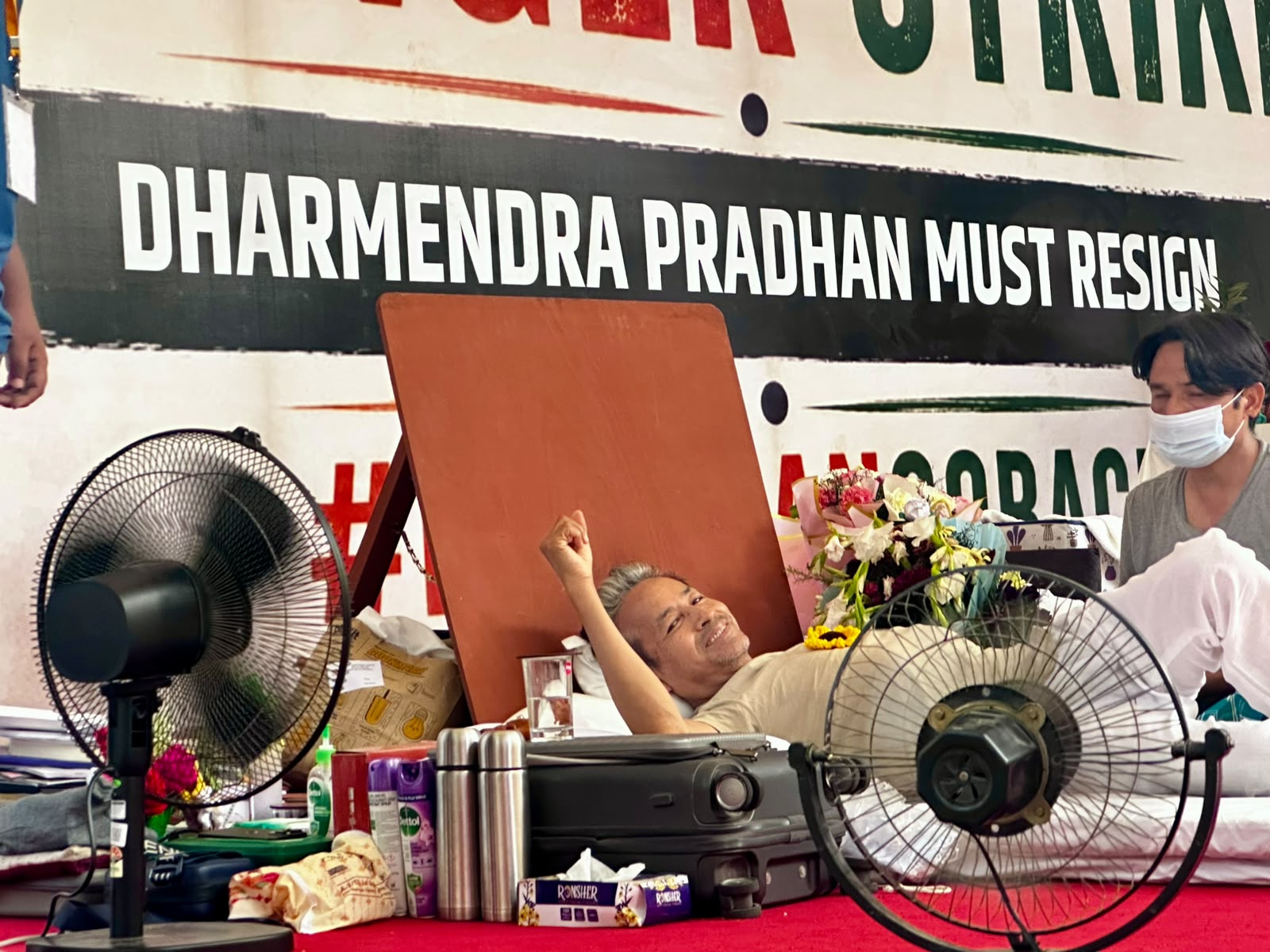
Sonam Wangchuk has been on an indefinite hunger strike at Jantar Mantar since June 28, has lost between 8 and 9 kilograms in body weight, his blood pressure and blood sugar have both fallen, and doctors monitoring him around the clock describe muscle wasting and continuing pain.
He remains conscious and is refusing to end his protest despite appeals by civil society leaders who met him on July 15, and calls by several political leaders, including Dalit Member of Parliament 'Ravan' Chandrashekhar Azad, and says he will join a march to Parliament planned for July 20.
The Delhi High Court is hearing a petition asking it to order his hospitalisation and, if necessary, force-feeding, but the Union government has yet to file a formal response to either the protesters' core demand or the court petition concerning his health.
Wangchuk, a popular Ladakh environment activist and educationist who was loosely modelled by a successful Bollywood film, joined the protest in solidarity with the Cockroach Janta Party (CJP) and its founder, Abhijeet Dipke, who are demanding the resignation of Union Education Minister Dharmendra Pradhan over the May leak of the NEET medical entrance examination paper.
The CJP, whose own sit-in at Jantar Mantar has now run for more than 25 days, itself emerged from a specific incident. On May 16, Chief Justice Surya Kant was reported to have referred to unemployed young people as "cockroaches" and "parasites."
He later said he had been misquoted and that his comment was directed only at those using bogus qualifications, but the remark, accurate or not in its reporting, struck a nerve among young Indians already anxious about their prospects.
Dipke, who is based in Boston, posted online asking what would happen if all the "cockroaches" organised, and within a week the campaign's Instagram following had surpassed 2.20 crore, centred on a mascot cockroach in a suit — a mild parody of the ruling party's visual style.
The movement describes itself as representing "the lazy, the unemployed, and the chronically correct."
That online campaign found a concrete cause in the NEET leak, which the CJP says has affected more than 20 lakh exam aspirants and which has been linked to several student suicides.
The National Testing Agency, which administers the exam, has faced repeated criticism over irregularities in past years; this is not the first such controversy, though the scale of anger this time has been larger and more sustained. NEET remains, for lakhs of Indian families, the single gateway into medical education, and a leak at that scale is understood by aspirants not as an abstract administrative failure but as a direct threat to years of preparation and, in many households, to the financial sacrifices made to fund coaching and repeated attempts at the exam.
That is part of why a satirical online campaign built around a joke about cockroaches was able to convert, within weeks, into a physical sit-in fifty metres from Parliament House.
Wangchuk's own profile has given the protest a visibility it might possibly not otherwise have had. An engineer by training, he is best known for his education reform work in Ladakh and for developing low-cost solutions to water scarcity in the region, including artificial "ice stupa" glaciers used to store winter meltwater for spring irrigation.
He inspired a central character in the 2009 film 3 Idiots, played by actor Aamir Khan, and has periodically drawn national attention to Ladakh's environmental and constitutional concerns, including an earlier hunger strike and a spell in detention connected to protests over Ladakh's status following the 2019 reorganisation of Jammu and Kashmir.
That history is part of why his decision to fast in solidarity with a youth-led exam-reform protest, rather than on a cause specific to Ladakh, has been read by many commentators as a deliberate broadening of his public role.
The government's public position has hardened rather than softened as the fast has continued.
Pradhan has dismissed Dipke, Wangchuk and the wider protest as a "B-team of disruptive elements." Neither he, his ministry, nor the government's chief spokesperson has responded substantively to the demand for his resignation.
The Centre's counsel was absent when a Delhi High Court PIL on Wangchuk's health was first mentioned on July 15, prompting the bench of Chief Justice DK Upadhyaya and Justice Tejas Karia to note the absence, call the matter urgent, and list it for the following day with directions that copies of the order be served on the Additional Solicitor General and the Delhi government's standing counsel.
The petition, filed by advocate Rakesh Kumar Saini, argues that Wangchuk's life is at serious risk and asks the court to direct the Centre and the Delhi government to move him to a hospital and administer a liquid diet if necessary. It also argues, more pointedly, that the government has been treating him "like a hardcore criminal, terrorist or traitor to the nation" rather than engaging with his demand.
Around the protest site, the state's posture has been considerably more active than its public statements suggest. Delhi Police have layered barricades around Jantar Mantar, installed extensive CCTV coverage, and deployed roughly 270 body-worn cameras on personnel at the site. Vehicles are being checked at entry and exit points across the city, and police sources have acknowledged monitoring both the physical crowd and social media discussion of the protest.
Protesters and some civil liberties observers say facial recognition units and additional control vehicles are stationed nearby, though police have not confirmed this in any public record.
The political response has been extensive but uneven, and it has not broken along a single party line. Chandrashekhar Azad, the Nagina MP and Bhim Army chief, visited Wangchuk on July 15. Former Maharashtra Chief Minister Uddhav Thackeray visited on July 13.
CPI former MP Subhashini Ali, Shiv Sena (UBT) leader Arvind Sawant and former Kerala health minister KK Shailaja have also visited, as have Samajwadi Party representatives Priya Saroj, Atul Pradhan and Man Singh Yadav. AAP's Arvind Kejriwal has voiced support for the cause, as has Trinamool Congress chief Mamata Banerjee, who has appealed publicly for Wangchuk to end his fast while continuing to back the underlying demand.
Congress MP Shashi Tharoor wrote an open letter urging Wangchuk to stop, framing the fast as having already "awakened the conscience of the nation" and arguing that his voice is needed for what comes next, particularly with Parliament's monsoon session resuming. Another Congress MP, Adhir Ranjan Chowdhury, has also backed the protest.
The CJP itself has invited senior BJP figures, including party president Nitin Nabin and his predecessor JP Nadda, to join the sit-in — a detail that complicates any straightforward reading of the protest as a simple opposition project.
Members of the Left-wing All India Students' Association are on a separate, parallel hunger strike at the same site, also now past their eighteenth day, under similar medical supervision. Their presence is worth noting on its own terms: this is not simply a protest built around one prominent figure, but one in which younger, less visible participants have taken on comparable physical risk without comparable attention.
In the Delhi High Court, petitioner Saini described the situation as one in which a citizen exercising his constitutional right to protest was, in practical terms, placing his own life at risk in full public view while the state declined to respond.
Civil society's response has been mixed — more than 1,800 writers, academics and activists — the count has been reported above 1,821 — signed an open letter asking Wangchuk and the fasting students to stand down, while stating full solidarity with the demand for Pradhan's resignation.
The People's Union for Civil Liberties issued a statement this week praising the protesters' courage while describing the government's non-response as "criminal indifference."
The most conspicuous absence from Jantar Mantar has been Rahul Gandhi. He has not visited the site and has not commented specifically on Wangchuk's fast, even as Congress runs its own separate campaign against Pradhan called "Chhatron Ki Goonj."
Wangchuk, in an interview with the Indian Express, called the wider Opposition's non-participation "pettiness" and said young voters would judge parties that stayed away. Uddhav Thackeray has publicly urged Gandhi to visit. The BJP has, separately, used Gandhi's unrelated three-week absence abroad earlier this year as a talking point against him. However, that criticism does not really engage with the narrower question Wangchuk and others have raised: whether a party that positions itself as the voice of India's students has shown up where those students actually are.
That question is being asked seriously, including by people who have no particular interest in embarrassing the Congress, though party cadres across many cities and towns have staged demonstrations, braving police water cannons and baton charges.
Whether the CJP amounts to a genuinely leaderless, youth-driven movement, or whether it is becoming, in practice, a stage that most opposition parties are willing to use except the one that would benefit most from the association, is now an open and consequential question for how seriously to take the Opposition's broader claims about representing young India.
A citizens' appeal circulated this week attempted to set out reasonable terms for de-escalation. It noted that more than 20 lakh families have been affected by the NEET leak, that student suicides have been linked to it, and that the National Testing Agency has failed, again, in its basic mandate.
It asked the government for concrete steps — compensation for affected families, credible safeguards against repetition, and an honest account of what went wrong — and, on that basis, asked the protesters to stand down, arguing that their point had already been made. It also asked all political parties, not just the BJP, to send a joint delegation to Jantar Mantar and commit to raising the matter when Parliament reconvenes.
It is closer to the minimum a government owes citizens who have chosen to put their health at risk to be heard, and the minimum an opposition owes voters who expect more than statements issued from a distance.
A march to Parliament is planned for July 20, timed to the opening of the Monsoon Session. Today's hearing in the Delhi High Court, and whatever the Centre finally puts on record, will likely determine what state Wangchuk is in by the time that march takes place — and whether the government's approach to a hunger strike three weeks old, and to the medical crisis it has produced, is dialogue or a hospital admission secured through the courts rather than through any acknowledgment of the underlying demand.
.jpg)
 A. J. Philip
.png) Jacob Peenikaparambil
Jacob Peenikaparambil
.jpg) Renjith Leen
Renjith Leen
.jpg)
.png)
.png) Robert Clements
Robert Clements
.jpg) A. J. Philip
A. J. Philip