

.jpg)
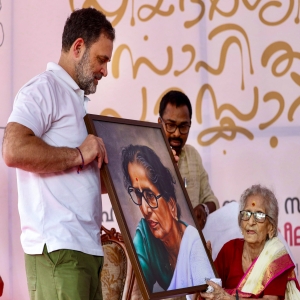
Rahul Gandhi, the Leader of the Opposition in the Lok Sabha, while presenting the Priyadarshini Literary Award to a veteran writer, educationist and literary critic of Kerala, M Leelavathy, on January 19, 2026, in Kochi, recalled her expressing concern about the culture of silence pervading across the country. He calls the culture of silence a culture of cowardice.
What she said was very powerful, which made him deliver an apt, powerful speech at the Maha Panchayat of elected local body representatives:
"The ideological attack of the BJP and the RSS is designed to create a culture of silence. They want compliance from the people of India. They want an India where all our assets, and the assets of the people, belong to a select few. And they know the only way this is possible is if the democratic voice of the Indian people is silenced. All over the country we see people who think something and believe something, but have no courage to say it. Great nations are not built in silence. Great nations, great people are built when they express their views, their opinions, and fight for their views and opinions. Embedded in the culture of silence is the idea of greed, that it doesn't matter as long as I am getting what I need. I don't need to say anything, I can watch people being humiliated, people being murdered, people being killed. As long as I am OK, everything is OK."
This is the demeaning culture of silence - an environment where fear and intimidation suppress open communication, forcing individuals to stay silent about issues, mistakes and misconduct. It is a toxic atmosphere characterised by condescending behaviour, such as talking down to others, and by sarcasm designed to belittle individuals. Fear of consequences makes people stay silent and avoid questioning authorities. Leaders who promote sycophancy create an environment where only' yes men' thrive.
It is important to remind ourselves that if our great leaders of the freedom movement were cowards and observed the demeaning culture of silence, India would never have gained independence, and we would have continued to live enslaved lives as subjects of the imperial British Empire. The Non-Cooperation Movement, the Poorna Swaraj and the Independence Pledge Resolutions, the Civil Disobedience Movement, and the Quit India Movement of the freedom struggle were the acts of very brave and courageous leaders who sacrificed comfort and everything to liberate India.
Narendra Modi is silent on the issues affecting the world order, is more interested in domestic politics, and is singularly obsessed with winning elections to secure and retain power by hook or crook. The Godi media presented him as 'Vishwa guru' before the advent of Donald Trump. Now with Trump bullying India and the world, the Godi media is silent. Modi is silent on the developments in Iran. In a shocking development, India has liquidated assets in the Chabahar Port Project, about which Modi had once boasted, under US pressure. India invested nearly ?1,100 crore in the Project, which has gone down the drain overnight.
Singapore's ex-foreign minister George Yong-Bon Yeo, a distinguished scholar on diplomacy, says, "Trump is a bully. If you show weakness, he'll be all over you. India cannot afford to look weak. If India just rolls over, it would lose its prestige and its reputation in the world." This is what is happening to Modi's India: loss of face and credibility in the community of nations.
Trump wants to annex Greenland at any cost. He announced imposing 10% tariff on eight European countries – Denmark, Norway, Sweden, France, Germany, the UK, the Netherlands, and Finland, 'until total purchase of Greenland.' The European countries reacted to Trump's blackmail. He says that, since the Nobel Peace Prize was not awarded to him last year, despite his having solved some eight international conflicts, including the Indo-Pak conflict of May 2025, he is now under no obligation to work for international peace. Yet, disgracefully, he accepted the Nobel Prize presented to him by Maria Machado.
On January 20, Trump shared a post showing an old photo of himself with European leaders with an altered US flag depicting Canada, Greenland and Venezuela as part of the US. In the post, Trump is seen seated in the Oval Office with French President Macron, Italian PM Meloni, UK PM Starmer, among others. Macron said Europe would not give in to Trump's bullying and "will not accept the law of the strongest." At the World Economic Forum in Davos, he said, "doing otherwise would lead to their vassalisation. And we do prefer the rule of law to brutality."
The European Commission President Ursula von der Leyen pushed back against Trump's 10% tariff announcement, saying, "The EU and the US have agreed to a trade deal last July. Plunging us into a downward spiral would only aid the very adversaries we are both so committed to keeping out of the strategic landscape." And she vowed EU's response "will be unflinching united and proportional." Flames from Trump's inflammatory approach to Europe over Greenland are now spreading to the island of Diego Garcia in the Indian Ocean, having serious security implications for India.
In a speech to the World Economic Forum (WEF) on January 21, after days of transatlantic tensions over his plans to annex Greenland, Trump said he wants immediate talks on the issue. Give up Greenland or else... Trump tells Europe and NATO: "You can say yes, and we will be very appreciative, or you can say no, and we will remember."
The UN secretary-general, António Guterres, warned: "When leaders run roughshod over international law, choosing which rules to follow… they are undermining global order, setting a perilous precedent. "And Norway, Germany, Sweden, France and Italy have refused to join Trump's Board of Peace for Gaza. The world is heading toward a new flash point. When the top leaders of some 110 countries were present at the WEF, Narendra Modi chose to skip the Forum meeting. He is silent on the Greenland issue.
Just as America under Trump is unsettled both domestically and internationally, India, too, under Modi is unsettled at home and abroad. On the eve of the 76th anniversary of the Republic, India is confronted with a serious constitutional crisis. The integrity of the very custodian of democracy, the Election Commission, is questioned. The EC's independence is compromised, and people lose faith in the electoral process due to its partisan, arbitrary, and unilateral functioning.
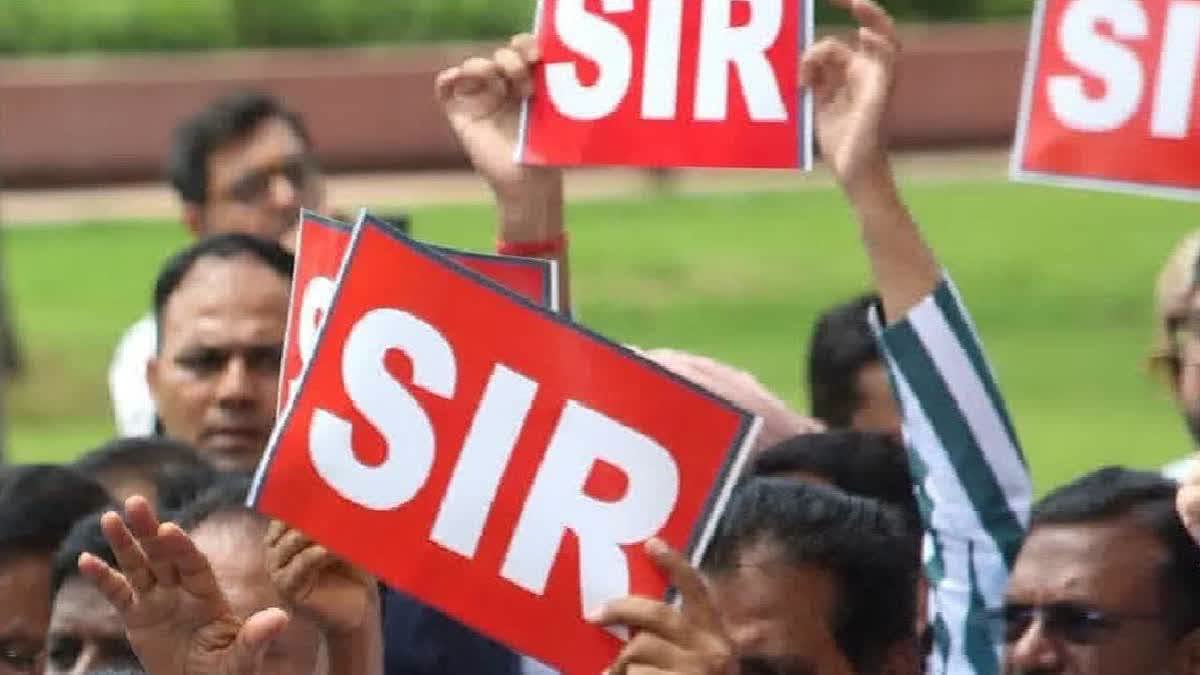
The SIR exercise is made very complex, leading to millions of voters disfranchised in every state. Allegedly, the SIR has disfranchised nearly 30 million people in Uttar Pradesh. Chief Minister Yogi Adityanath asked party cadres to enrol 200 new voters in every booth to compensate for the loss; a bizarre development. The Judiciary is not able to address the problem satisfactorily. There is no answer to the charge of vote theft. This is a new, scary development in independent India, raising doubts about the survival of democracy.
And yet, in the face of backlash against the role of the Election Commission of India (ECI) and its failure to ensure free and fair elections and safeguard democracy, here comes the news that the ECI is organising a three-day international conference on 'Democracy and Election Management' between January 21 and 23 in New Delhi, at a time when the credibility of the ECI is all-time low. Around 100 delegates from over 70 countries are expected to participate in the conference.
Ironically, the conference is being organised by the India International Institute of Democracy and Election Management, an ECI body. The ECI is better advised to set its house right first and reflect on the erosion of its credibility.
The central agencies, such as ED, CBI, and IT, are abused and misused to target the opposition parties and their leaders months before the elections to intimidate and silence them. The agencies have been weaponised to subserve the political interests of the ruling regime at the Centre.
Communal politics has taken its toll. Both Narendra Modi and Amita Shah – the top two leaders running the government - constantly invoke the question of infiltrators, particularly during election campaigns and rallies. They accuse the opposition parties, mainly the Congress and the TMC, of shielding the infiltrates for vote bank politics, without any evidence, to polarise the people. If there are infiltrators from across the borders, the Union Home Ministry should be held responsible for failing to detect and deport them. Religious sentiments and divisive politics tear apart the fragile social fabric. There is growing fear, intolerance and violence. Any criticism of the government is quickly equated with anti-national activity and dubbed as anti-patriotic.
The music maestro AR Rahman, who brought laurels to India by winning an Oscar award as music composer, in a recent interview with the BBC Asian Network, said that he was getting less work these days: "People who are not creative have the power now to decide things ... this [Chhaava] might have been a communal thing. "He was trolled for this. And Kangana Ranaut, BJP MP, was quick to react: "I desperately wanted to narrate my directorial Emergency to you… I was told you don't want to be a part of a propaganda film."
The criminals committing atrocities on the weaker and the marginalised, women and children, go scot-free and roam freely. The critics of the government are arrested on false charges by invoking the stringent draconian laws - PMLA and UAPA - and languish in jails without bail and trial for years, the process itself becoming the punishment, depriving them of life and liberty. This will put even the dictatorial and autocratic regimes to shame.
The governors in non-BJP-ruled states are a law unto themselves and run parallel governments. Take, for instance, the role of governors in the non-BJP southern states. The Assembly sessions in Kerala and Tamil Nadu got off to a dramatic start on January 20. In Kerala, the Governor Rajendra Vishwanath Arlekar omitted parts of the speech, and CM Pinarayi Vijayan read out the skipped portions after the Governor left the House. And in Chennai, Governor RN Ravi walked out of the Assembly for the fourth year in a row, without delivering the inaugural speech.
While the Kerala Governor said the speech given to him by the government contained "half-truths," his Tamil Nadu counterpart claimed the speech given to him was "laced with unsubstantiated claims and misleading statements." After Tamil Nadu and Kerala, it is the turn of Karnataka Governor Thawar Chand Gehlot, who refused to address the joint legislature session that began on January 21, demanding the deletion of 11 paragraphs from the speech.
How will the state governments function if the governors appointed by the BJP government at the Centre behave like this? Someone should ask these Governors: what would happen if the President of India, Draupadi Murmu, chose to skip the inaugural speech prepared by the Modi government and leave the Parliament abruptly!
Higher Education in India is at a crossroads. Quality education is becoming increasingly inaccessible and unaffordable to the vast majority of people. The number of universities had doubled over the past decade, rising from 760 in 2014-15 to 1,338 as of June 2025. And the number of colleges increased from 38,498 to 52,081 during the same period.
The indiscriminate privatisation has resulted in the corporatisation and commercialisation of education and the mushrooming of coaching centres across the breadth and length of the country. Teaching and learning are outsourced. There is an acute shortage of teachers, with contract and clock-hour appointments replacing regular appointments. The present education system demands compliance, rather than encouraging independent and critical thinking. And the academic community is silent.
The Modi government is opposed to dialogue, discussion, and debate that strengthen democracy. Nobody wants to question the government. It is imperative that the media, intellectuals, teachers and students, writers and opinion makers, organisations of civil society and the people at large stand up and speak against the wrongdoings, and contribute to informed public opinion and make the government responsible and accountable, instead of being intimidated and silenced. The demeaning culture of silence is doing immense damage to the nation.
.jpeg)
 A. J. Philip
.jpg)
.png) Jacob Peenikaparambil
Jacob Peenikaparambil
.jpg)
.png) John Dayal
John Dayal
.jpg)
 Pachu Menon
.jpg)

.png)
.png)
.png) Robert Clements
Robert Clements
.jpg)