

.jpg)
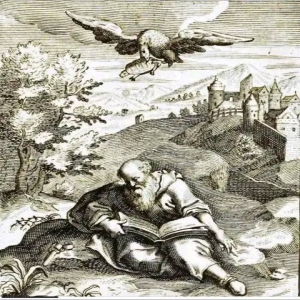
Aeschylus, the Greek tragedian, wanted to know how he was destined to die. Hence, he consulted a fortune teller who told him the truth and nothing but the truth. "You would meet your death under a falling house and get crushed." The dramatist who made the struggle and crisis of his own days his raw material decided to escape such a tragic death. Hence, he spent most of the days in the open country.
The appointed day of his death came, of course, without announcement. As he was standing bare-headed, enjoying the many splendoured nature in the field, a vulture mistook his bald pate for the top of a rock and dropped the tortoise it was gripping in its talons right on it. And the poor dramatist was crushed to death in the middle of the field.
No living being can add or deduct a second from the stipulated time. It will come when it will come. And we all know that Death has a hundred hands and walks in a thousand ways. It is said that Yama, the Lord of Death, would not like to be blamed for his actions. That is why one stumbles on a blade of grass and meets death. Another champion swimmer drowns in a pool of water with a hidden live wire. Yet another person crossing the road is run over by a speeding van.
No one knows for sure how and when one is destined to die. But one thing is certain. The first breath is the beginning of death. Was not Benjamin Franklin right when he humorously said: "In this world nothing can be said to be certain but death and taxes?" One is reminded of Niccolo Machiavelli, author of 'The Prince,' who, on his deathbed, blabbered: "I desire to go to Hell not Heaven. In Hell, I shall enjoy the company of popes, kings, and princes but in Heaven only beggars, monks, hermits and apostles."
There is no escape from fate. What is written is written, and what is written can never be erased, even if the Divine wills it. That is why Shakespeare's KING JOHN aptly ruminates: "Think you I bear the shears of destiny? Have I commandment on the pulse of life?" (Act IV, sc.2. lines 91 & 92)
Our fate is in our stars, and they guide us. We have to follow them blindly, and if we open our eyes, we may fall into a ditch. All that we can do is helplessly watch what is happening around us and to us. No complaints... No grudges... And believe whatever happens, happens for our good. Take it as it comes… every day a lesson. And the inimitable master who teaches us is fate.
The eminent 13th-century Persian poet Jalal al-Din Rumi tells us a story. According to the poet, Jesus was travelling when a stranger joined him. Before long, the companion stopped near a ditch, and his eyes widened. He saw a strange skeleton there. He poked it with a stick he had in his hand. Then he looked at Jesus and said: "Oh, Prophet! You are well known as a miracle worker and if you can teach me the occult art of raising the dead from the grave, I can also bring back this skeleton of a creature to life and thereby become famous like you."
Jesus kept quiet. The stupid fellow kept pestering the Lord, who got annoyed. When he repeated his request, Jesus gave a bit of his mind. "Remember this is no easy work for a commoner like you. First and foremost, you need a soul as pure as the purest thing on Earth. Secondly, your behaviour should be on a par with angels. Above all, you should live many lives in the holiest possible ways. Imagine the stick you have in your hand as the staff of Moses. By simply holding it in your hand can you ever become Moses?"
The stranger got snubbed and became silent for a while. Then he articulated with a bang. "So, you think I am a misfit for the task. So let it be. But aren't you an expert in bringing the dead back to life? So please help this poor skeleton".
Jesus was in a quandary. He began to wonder why that nincompoop was interested in reviving the forsaken bones. Hence, he sought God for help. God answered, and his voice was audible only to Jesus. "This is how Fate works. Pathetic people are ordained to dig their own grave. They are destined to reap whatever they sow".
Jesus sent up his prayer... The bones gathered themselves and, in a jiffy, sprang up a lion that immediately pounced on the stranger and tore him to shreds. Jesus helplessly watched the gruesome scene. A few seconds later, he asked the lion why it killed the man, who was in a way responsible for bringing it back to life. And the lion replied, "That is because he annoyed you ... angered you."
"Then why you did not eat his flesh?" Jesus wanted to know.
"How can I when the dead man's flesh is not destined for my stomach today. It is fate that decides my food," said the lion humbly and walked away.
.jpg)
 A. J. Philip

.png) Cedric Prakash
Cedric Prakash
.jpg)
 P. A. Chacko
.jpg)
.jpg)
.jpg) Thomas Menamparampil
Thomas Menamparampil
.png)
.png)
.png) Robert Clements
Robert Clements
.jpg)
.png)
.png) Chhotebhai
Chhotebhai