

.png) Dr Suresh Mathew
Dr Suresh Mathew
“People who are out of a job are the stuff out of which dictators are made,” said Theodore Roosevelt, former President of the United States. To paraphrase it differently, rulers who are out to destroy the democratic norms and rule of law are the stuff out of which dictators are made.
The governments, under dictatorial leaders, are taking law into their hands to inflict further woulds on the brutalised minorities. The latest is the violence in Haryana’s Nuh and Gurugram. The spark for the Nuh riots came from a procession by the VHP, in which a controversial person, allegedly involved in the killing of two Muslims, was rumoured to take part.
Members of the minority community gathered in good numbers to counter the procession, and the result was diabolical: killings, torching of vehicles, razing worshiping places and other structures to the ground; and the violence continued unabated for four days.
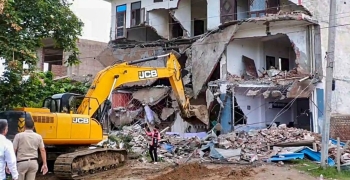
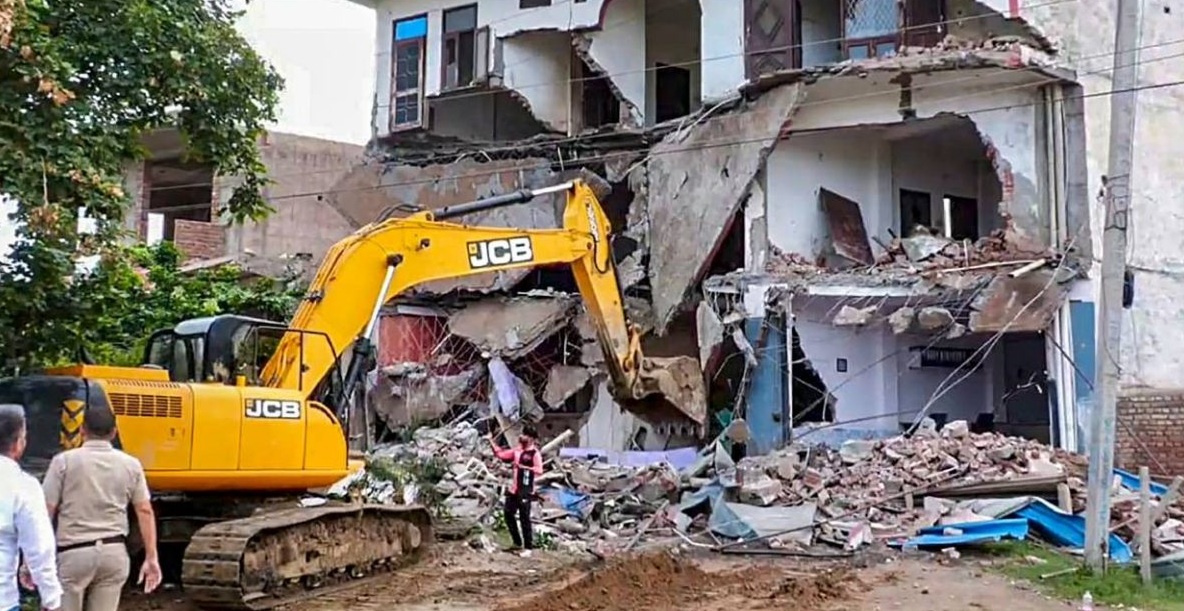
This blood-soaked story is a familiar one embedded in the minds of people. Now a new element has been added to the barbarism unfolding in States ruled by the BJP. It is the demolishing of structures by bulldozers, after every such violence, with the government claiming that they are illegal; but what is left unsaid is that every structure bulldozed belongs to members of the minority community.
The gravity of this lawless action is that neither any notice is issued to the occupants of the demolished buildings nor they are given any time to vacate them. It is probably this ‘illegality’ that forced the High Court to order immediate halt to ‘bulldozer justice’ in Nuh where scores of buildings were brought down. Earlier, the Supreme Court too had intervened to halt such demolitions.
What is more frightening is that the bulldozing mania is fast spreading. It started in the neighbouring Uttar Pradesh under BJP Chief Minister Yogi Adityanath. Crimes and criminals are to be dealt with as per the law of the land, or else the pillars of democracy will fall apart. But what happened in UP, Madhya Pradesh and Haryana is nothing but mockery of law.
The state governments, bound to follow the rule of law, are routinely deploying bulldozers to raze to the ground houses, shops and other establishments of the alleged violators of the laws of the land. Two things make this government move dreadful: one, the administration doesn’t give a damn to even court orders and deploy bulldozers; two, they are used to flatten structures in areas mostly occupied by a particular community.
This raises numerous unpalatable questions. The powers-that-be have neither stated the laws under which they ordered the deployment of bulldozers nor come out with the criteria to bulldoze the buildings. If the government claims that they have razed illegal structures, why did it wait till the riots to take place to swing into action? Is it merely a coincidence that the buildings demolished belong to a particular community alone? Aren’t there illegal structures built by people of other communities? Is it a mere accident that they escaped the cutting edge of the bulldozers? Aren’t houses belonging to people who have nothing to do with riots or communal violence demolished? As the BJP government at the Centre is reaching the fag end of its second term, it is leaving behind too many sore points and unhealed wounds, puncturing the very soul of India.
.jpg)
 A. J. Philip

.png) Cedric Prakash
Cedric Prakash
.jpg)
 P. A. Chacko
.jpg)
.jpg)
.jpg) Thomas Menamparampil
Thomas Menamparampil
.png)
.png)
.png) Robert Clements
Robert Clements
.jpg)
.png)
.png) Chhotebhai
Chhotebhai